Corporations have tried to boost their business value through a number of propositions in order to gain market competitiveness. It is critical to understand their organisational leadership, dynamics, and management, as well as how they work together to achieve desired outcomes. It is also critical to ensure optimal alignment between strategy, operational level plans that divide the strategy into manageable activities, institutional systems and processes required for successful execution, and the tactics, techniques, and procedures used by the organisation’s front-line employees and supervisors in their day-to-day activities, tasks, and routines. The three primary types of leadership found at each organisational and managerial level are depicted here.
Strategic Leadership
A core business strategy entails using an organisation’s distinct capabilities to gain and maintain a competitive advantage. This allows the organisation to efficiently serve its clients or partners while maintaining its ability to thrive, grow, and adapt to changing situations. Strategic leaders, who set the tone for the entire organisation, must be ethically, professionally, and technically competent. They must establish a clear vision and mission to everyone in the organisation and communicate this purpose to the outside world. Furthermore, strategic leaders must strike a balance between the organisation’s aims and aspirations and the demands of its internal and external stakeholders.
Strategic leaders are effective influencers and organisers who understand power dynamics, the social environment, economics, technology, and market demands. They should have high levels of self-esteem, self-knowledge, self-efficacy, and self-control, which can be obtained through self-awareness, experience, and skill in a variety of subjects. They should also have a strong understanding of human nature, including the behaviour of their clients, employees, patrons, and owners.
Successful strategy implementation necessitates rigorous planning and execution. Operational leaders ensure that the plan remains on track and aligns with the organisation’s goals. These leaders translate strategy into practical plans for divisions and departments, as well as systems, structures, procedures, and processes that support tactical leaders and their teams’ performance.
Operational Leadership
Operational executives and leaders must strike a balance between the organisation’s needs and those who carry out the purpose and vision. Standardisation, performance reporting, resource allocation, budgeting, and other administrative activities are critical to operations. However, these processes should not overwhelm the organisation’s primary goal.
Small triumphs in daily chores and missions lead to a successful strategy, whether planned or unplanned. An organisation flourishes and expands when it achieves everyday tactical successes.
Tactical Leadership
Tactics include tactics and procedures. Tactical leaders and front-line staff carry out their responsibilities using suitable tactics, techniques, and procedures. Standardising these procedures enables teams to successfully combine functional parts and establish synergies, allowing tactical teams to advance, compete, and win, resulting in the implementation of higher-level managerial strategies. Standardising strategies, techniques, and processes helps businesses achieve a uniform approach to manufacturing, sales, supplier and distributor contacts, customer relations, and other essential external operations. These standards are also critical for internal operations such as training, hiring, selection, professional development, and other support functions inside a large firm.
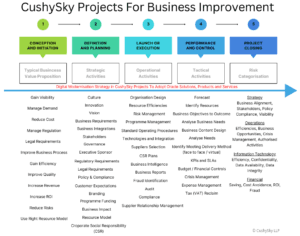
We understand that when a decision is authorised and implemented across the board, from executive to middle management to teams and employees, it can be a challenge to maintain the quality and consistency of the project implementation as well as deliver the best performance. In order to carry out successful business improvement through digital modernisation in corporations, there are many internal and external factors, crossfunctional efforts, teams, and subject matter experts that need to be aligned with expert advice and consultation as smart strategies to move the organisation forward.
When an imminent major change is about to happen, it is project-managed in phases from the initial conceptual phase to the definition of the planning phase to the executing phase to the performance benchmark of the controlling phase to the last closing phase. At CushySky, we provide guidance for organisations to navigate the digital modernisation projects as well as minimise the risks to adopt Oracle solutions, products, and services.